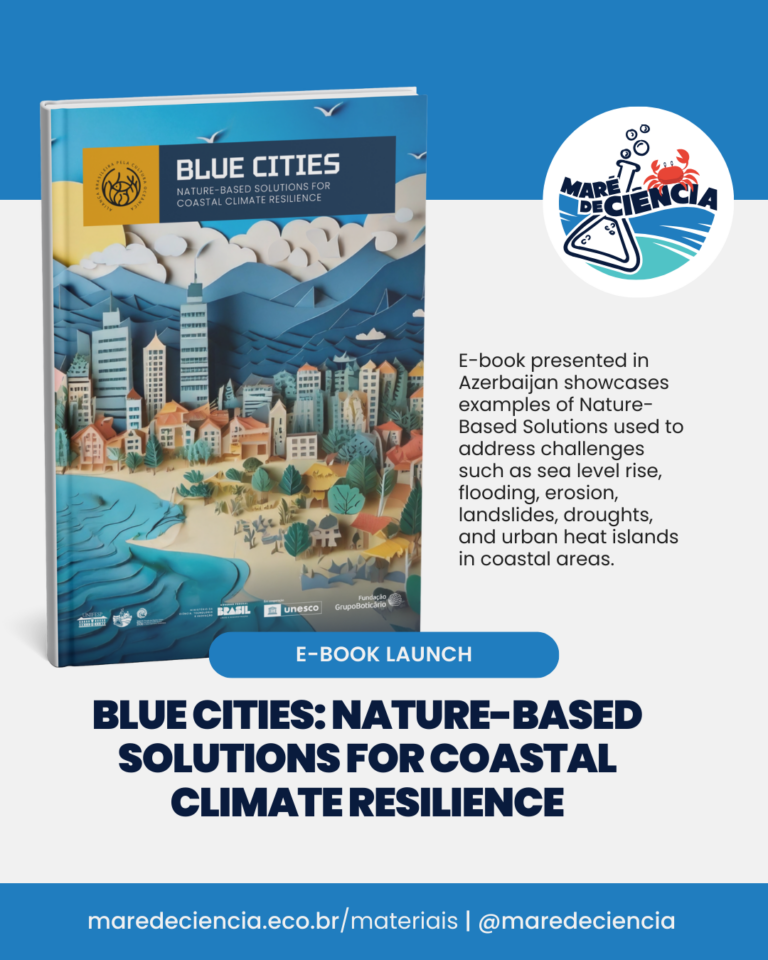
E-book Presented in Azerbaijan Showcases Nature-Based Solutions to Tackle Challenges Such as Sea Level Rise, Flooding, Erosion, Landslides, Droughts, and Urban Heat Islands in Coastal Areas
Scientific projections indicate that the frequency and intensity of extreme weather events are expected to increase, making the implementation of effective adaptation and mitigation strategies urgent, especially in coastal regions.
Through practical examples and reference projects already implemented in Brazil and worldwide, the study developed by the Brazilian Alliance for Ocean Culture aims to inspire decision-makers in both the public and private sectors.
Brazilian cities located in coastal zones are particularly vulnerable to climate change and must become more resilient to extreme weather events, which are expected to become more frequent and intense, according to studies published by the Brazilian Panel on Climate Change. To address this challenge, the Brazilian Alliance for Ocean Culture presents the study “Blue Cities: Nature-Based Solutions for Coastal Climate Resilience”. The material was launched on November 11, 2024, during COP29, the United Nations Climate Change Conference, held in Baku, Azerbaijan.
Designed in an educational and solution-oriented format, the publication maps out the main risks faced by Brazilian coastal zones and presents examples of Nature-Based Solutions (NbS) for cities to adapt to this evolving scenario. The goal is to support decision-makers, public administrators, legislators, investors, and the general public by providing science-based information and successful experiences to tackle challenges such as sea level rise, strong winds, storm surges, flooding, erosion, landslides, urban heat islands, and biodiversity loss.
The publication was launched by the Brazilian Alliance for Ocean Culture, an initiative coordinated by the Federal University of São Paulo (UNIFESP), the Ministry of Science, Technology, and Innovation (MCTI), and UNESCO, with the cooperation of the Boticário Group Foundation for Nature Protection and support from the São Paulo Research Foundation (FAPESP).
“We need to develop innovative and scientifically grounded solutions to address the challenges of coastal cities in an integrated and effective way, benefiting both society and the environment,” says Ronaldo Christofoletti, professor at UNIFESP and member of the Nature Conservation Experts Network (RECN). “To overcome the rigidity of gray infrastructure, green and blue solutions—such as mangrove and dune restoration, the creation of linear parks, and green roofs—enhance urban resilience and create healthier and more sustainable spaces for the population,” he adds.
According to the 2022 Census conducted by the Brazilian Institute of Geography and Statistics (IBGE), more than half of Brazil’s population (111 million people) live within 150 km of the coast. If we consider only those residing directly in coastal areas, the number exceeds 50 million, meaning that one in four Brazilians lives along the shoreline.
Scalable Nature-Based Solutions
The NbS projects cataloged in the publication launched at COP29 range from solutions that can be implemented by businesses and individuals, such as green roofs, rain gardens, and pocket parks, which help absorb rainwater and improve thermal comfort, to more complex initiatives, including eco-engineering solutions to mitigate the impact of ocean waves, coastal line redesign, floodable parks, linear parks, filtering gardens, ecological corridors, and bioswales. Additionally, the conservation and restoration of natural coastal ecosystems, such as forests, mangroves, salt marshes, dunes, and coral reefs, are also considered Nature-Based Solutions (NbS).
“More than just raising awareness about the risks of climate change, which are becoming increasingly well-known, we need to inspire decision-makers to adopt the best available solutions. It is essential to better understand and recognize the benefits that nature provides to cities, often in a more cost-effective way than conventional interventions, which are clearly insufficient for the new climate reality. Additionally, Nature-Based Solutions can also bring significant benefits to public health and well-being,” says Janaína Bumbeer, Project Manager at the Boticário Group Foundation.
Protection, Restoration, and Innovation
The study emphasizes that protecting natural marine and coastal ecosystems, such as dunes, salt marshes, floodplains, urban forests, and mangroves, should be a priority. In areas where these ecosystems have been degraded, restoration and recovery efforts should be promoted, including wetland and riverbank reforestation and coastal ecosystem rehabilitation. “In addition to these protection and restoration initiatives, innovative eco-engineering solutions can also be implemented, such as interventions designed to stabilize slopes, control erosion, and improve water infiltration in sloped areas—all while leveraging nature itself as a solution,” highlights Christofoletti.
Experts also emphasize that, in addition to helping cities adapt, Nature-Based Solutions (NbS) can play a crucial role in mitigating greenhouse gas emissions, the primary drivers of global warming. A recent study published on the scientific platform Global Change Biology reveals that NbS—particularly the protection of natural ecosystems and forest restoration—have the potential to mitigate up to 78% of the carbon emissions required for Brazil to reach its net-zero targets, making a significant contribution to the country’s climate commitments.
In addition to promoting carbon sequestration, as demonstrated in the study Oceano Sem Mistérios – Blue Carbon from Mangroves, natural ecosystems enhance biodiversity and ecosystem services, benefiting local communities. In various international forums, Nature-Based Solutions (NbS) are increasingly recognized as key strategies for mitigating greenhouse gas emissions and adapting territories to climate change. They are gaining momentum at UN Climate Change and Biodiversity Conferences (COPs) and are also integrated into the United Nations Sustainable Development Goals (SDGs).
About the Brazilian Alliance for Ocean Culture
The Alliance for Ocean Culture is a network of municipalities, states, private institutions, and organized civil society, engaged and mobilized in the implementation of local actions aligned with national and global goals of the UN Decade of Ocean Science. Its focus is on promoting Ocean Culture for sustainable development, fostering a growing movement toward the creation of Blue Cities. The Alliance is coordinated by the Maré de Ciência Program of the Federal University of São Paulo (UNIFESP), the Ministry of Science, Technology, and Innovation (MCTI), and UNESCO.